Business growth is not only driven by vision, but you also need powerful, intelligent technologies that enable it to scale effectively. In today’s competitive world, manual processes and legacy systems are no longer efficient to survive, let alone scale.
Enterprise Resource Planning (ERP) software is the central nervous system of a business. It connects, integrates, and automates the core business processes, including procurement, manufacturing/production, inventory management, sales/CRM, and finance. Businesses adopting ERP systems not only survive but thrive in this highly complex industrial landscape.
This blog explains the ways an ERP system supports businesses seeking to scale and grow globally.
What does it mean to scale and grow your business?
Scaling goes beyond growth; however, both terms are used interchangeably. Growth means increasing your business size and expanding operations, revenue, and market share. On the contrary, scaling a business means growing revenue at a much faster rate than the costs. This allows businesses to increase their capacity, sales, and market share without rising expenses.
In simple terms, growth is about getting bigger, while scaling is about becoming smarter and more efficient.
What is ERP? How does it support business scalability?
Enterprise Resource Planning (ERP) software is a consolidated platform that integrates core business departments, enabling businesses to manage, track, and view activities from a single platform. It stores all your data in a single database, providing a single source of truth. Any change made by your team in any module is reflected in all the related modules.
For example, if a salesperson creates an order, it instantly updates the inventory module. If the stock is available to fulfill the demand, it automatically alerts the distribution department to pick the order for delivery. Conversely, if the stock is unavailable, the system triggers the manufacturing module, creates a manufacturing order to produce the product, and then updates the inventory. The order is then picked, packed, and sent out for delivery.
Functionalities of ERP that help businesses to scale and grow
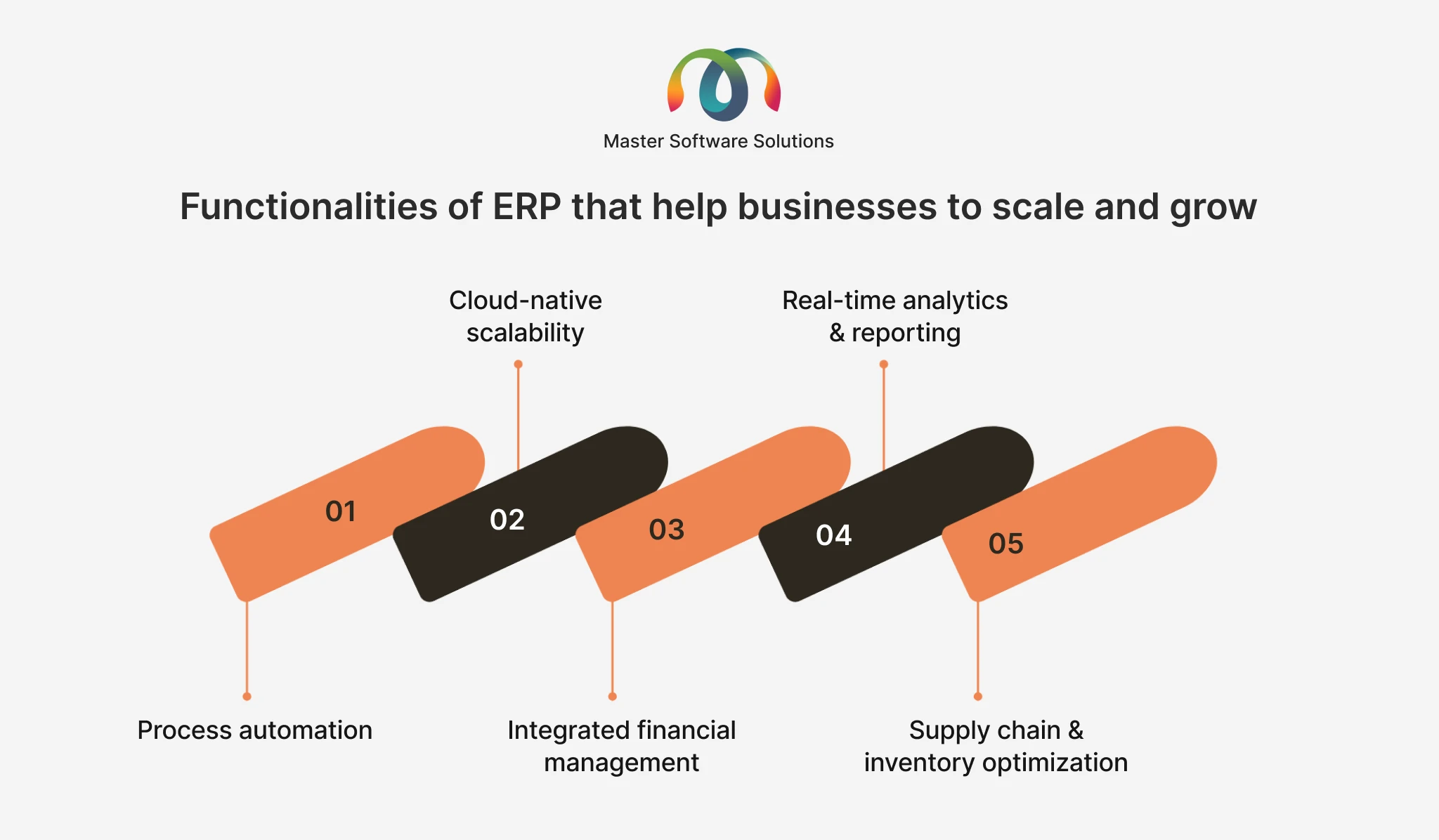
The ERP system offers centralized data, automates repetitive tasks, and provides real-time insights, enabling businesses to improve business efficiency and reduce operational costs. The system offers features that can eliminate data silos, allowing for faster, data-driven decisions during rapid growth. Here are the functionalities of ERP software that help businesses to scale and grow.
Cloud-native scalability
Cloud-based ERP systems provide flexibility, high performance, and cost-effective digital infrastructure. Unlike a legacy system, which is rigid, a cloud-based system uses microservices, containers, and APIs, enabling businesses to scale up or down instantly on demand without incurring significant upfront hardware costs. Here is how this happens.
Elastic resources
These systems can dynamically adjust CPU, RAM, and storage based on real-time demand, ensuring high performance during peak transaction periods and cost optimization.
Modular growth
The ERP system has a modular architecture that enables businesses to add, remove, or upgrade specific, independent modules. Being cloud-based software, it offers flexibility, a lower cost of ownership, and the ability to scale resources on demand.
Global expansion
The system supports multi-currency, multi-language, and multi-country regulations. This allows businesses to speed up expansion into new regions without going through complex, localized infrastructure setup.
Real-time data access
A centralized system enables businesses to access live data from multiple departments, ensuring consistent, quick, and informed decision-making across the organization.
Fast deployment
Cloud-based platforms are easier to implement and take 3 weeks to 4 months, based on your customization requirements.
Accessibility & mobility
The system removes physical infrastructure limitations, such as those in legacy systems, enabling real-time and on-the-go decision-making. It allows your team to access the system from anywhere and at any time, fostering a distributed, productive workforce.
Automatic upgrades
The system eliminates the need for manual, disruptive, and costly upgrades, allowing businesses to evolve in real-time alongside growing business demands.
Intelligent automation
It replaces manual, rigid, and resource-intensive processes with autonomous, elastic, and data-driven workflows. Embedding AI (Artificial Intelligence), ML (Machine Learning), and Robot Process Automation (RPA) directly into the ERP system enables it to handle increasing data, users, and transaction volumes without impacting performance.
Open APIs & integration
The system provides an interconnected ecosystem that enables you to integrate multiple third-party tools. They automate complex workflows, expand into new markets, and support increasing data loads.
Shift to subscription
Implementing an ERP system enables businesses to move from heavy capital expenditure on servers and hardware to a flexible operating expense subscription model. This frees up cash flow for growth initiatives.
Lower IT burden
ERP platforms reduce or eliminate in-house infrastructure maintenance, allowing internal teams to focus on strategic growth.
High availability & backup
These platforms offer superior, built-in disaster recovery and data backups, ensuring business continuity.
World-class security
ERP implementation service providers, such as Master Software Solutions, invest in advanced security measures, including data encryption and AI-based monitoring, often superior to what smaller businesses can manage on-premises.
Real-time analytics & reporting
Enterprise Resource Planning platforms are the “brains” of a growing business, which centralize data from various departments into a single database. Real-time analytics and reporting functionality in the ERP software replaces slow, manual processes with instant data-driven insights that allow proactive decision-making. Users can access these actionable insights from anywhere and at any time and make decisions, minimizing the impacts of disruptions. Here is how real-time analytics and reports help businesses to scale.
Agile decision-making
The system transforms your business data into immediate action, allowing businesses to scale effectively without becoming the victim of their own growth. They replace traditional, slow-moving batch reports with live, data-driven insights. This enables you to swiftly change course, maximize resources, and keep up excellent performance as you scale operations or enter new markets.
Operational efficiency
The ERP software replaces reactive, manual processes with proactive, data-driven, and automated workflows. This reduces operational costs, ensures data accuracy across departments, and enables businesses to handle an increased volume of data (customers, products, or transactions).
Accurate financial forecasting
The system can turn passive, historical data into actionable, forward-looking insights, enabling businesses to modify or create their strategies accordingly. With a single source of truth, ERP enables businesses to navigate the complexities of expansion, including increased volume, new markets, and higher operational intricacies.
Optimized resource management
This enables businesses to transition from a reactive, manual approach to a proactive, data-driven one. This ensures that as the business’s transactional volume and operational complexity increase, efficiency increases rather than diminishes. It allows for sustainable, cost-effective growth.
Enhanced customer experience
The ERP system facilitates business scaling by transforming operational data into actionable insights, enabling faster, more accurate, and personalized customer interactions. Its tools remove bottlenecks, minimize manual errors, and provide a 360-degree view of customer behavior, enabling efficient order management.
Process automation
The ERP software replaces manual tasks with streamlined and digital workflows, increasing productivity by 30% and lowering operational costs by 23%. It automates core business functions, such as finance, HR, and inventory management, reducing errors, accelerating workflows, and gaining real-time data for better decision-making, allowing them to scale efficiently. Key ways ERP automation fuels scalability and growth.
Improves efficiency
It allows businesses to increase transaction volumes without proportionally increasing overheads or headcount. Automation operations reduce errors, accelerate workflows, and provide accurate, real-time data, creating a stable, efficient foundation for expansion.
Scalable operations
The system eliminates manual bottlenecks, streamlines workflows, and provides real-time data for decision-making. Automating repetitive tasks, including invoicing, inventory management, and reporting, enables businesses to handle increased data volume without increasing costs. This ensures consistent efficiency during expansion.
Enhanced data accuracy & decision-making
The centralized platform replaces manual, error-prone, and slow processes with streamlined, real-time, and AI-driven workflows. The system automatically updates data from one module into another, minimizing the scope of manual errors and delays. This ensures seamless, faster data flow and informed decision-making.
Reduced operational costs
Automation frees up capital, increases efficiency, and allows businesses to handle higher transaction volumes without increasing linear costs. Automating repetitive tasks reduces labor expenses and errors, allowing your teams to focus on growth-oriented initiatives.
Faster customer response times
The system allows businesses to handle increased demand without increasing the headcount, driving efficiency, reducing costs, and boosting customer loyalty. Automating operations such as order processing, inquiry resolution, and inventory management enables you to maintain high-quality service, foster customer trust, and focus resources on strategic growth initiatives.
Flexibility for growth
ERP software allows businesses to increase transaction volumes, add customers, and expand operations without increasing operational costs or headcounts. It also replaces manual, error-prone tasks with standardized, automated workflows, maintaining operational efficiency and data accuracy during rapid growth.
Integrated financial management
The centralized ERP system unifies financial data across multiple business modules, automates accounting processes, and provides real-time analytics for faster decision-making. It offers flexibility and cloud-based infrastructure that support increased transaction volumes, reduce operational costs by eliminating manual tasks, and ensure regulatory compliance across various locations. Thus, supporting scalability. Here is how integrated financial management can help drive scalability.
Centralized financial control
The system centralizes all your financial data to coordinate and control all financial activities, offering a single, accurate view of the organization’s financial health. As businesses scale, transaction volume grows by 3-5X, creating significant risks related to revenue leakage and manual bottlenecks. Centralization standardizes, secures, and improves the efficiency of financial operations.
Core financial process automation
Automating core financial processes enables organizations to increase transaction volumes, expand operations, and improve financial accuracy without increasing headcount. Replacing manual, repetitive, and error-prone tasks with intelligent technology allows businesses to shift from traditional, spreadsheet-based finance to automated, real-time operations.
Real-time insights and reporting
This enables businesses to scale faster by replacing month-end, backward-looking reports with instant, data-driven decisions. Automation captures data across systems and offers real-time visibility into cash flow, burn rate, and KPIs, reducing risk and enabling agile, proactive adjustments to market shifts.
Regulatory compliance
The system automates complex tax/reporting tasks, reducing human error and ensuring real-time audit readiness across growing operations. It provides a centralized, secure, and transparent data hub to mitigate risks and allows businesses to expand into new markets while maintaining regulatory standards.
Improved cash flow management
Real-time visibility into financial data, accounts payable/receivable automation, and inventory optimization frees up working capital for growth. It replaces manual processes with accurate, automated forecasting, reducing costly errors and enabling faster, data-driven decisions on expansion and investment.
Supply chain & inventory optimization
The Enterprise Resource Planning (ERP) platform transforms fragmented processes into integrated, data-driven operations, facilitating sustainable growth. It integrates business departments such as procurement, manufacturing, warehouse management, and distribution to provide real-time visibility and automation. This reduces costs, improves accuracy, and enables businesses to handle increasing volume as they scale. Here is how supply chain and inventory optimization support business scalability and growth.
Enhanced visibility and data-driven decisions
The system provides real-time insights, reduces costs, and improves efficiency, supporting business scalability and growth. Replacing manual processes with centralized data enables you to forecast demand accurately, prevent stockouts, and optimize logistics.
Operational efficiency & automation
ERP software provides real-time, end-to-end visibility, reducing manual errors, cutting operational costs, and optimizing stock levels. These systems streamline procurement, automate order processing, and enhance demand forecasting. This allows businesses to handle increased volume, prevent stockouts, and improve profitability during growth.
Scalability for growth
The system integrates supply chain and inventory management into a unified platform that handles increased transaction volumes, data, and users without performance disruptions. This enables businesses to use real-time data to expand into new markets, optimize stock levels, reduce costs, and automate manual workflows.
Reduced costs and improved profits
Automation, centralized data, and improved efficiency help you cut operational costs and boost profits. Optimizing inventory, streamlining processes, and reducing manual errors enable businesses to lower overhead, freeing up capital for expansion. Real-time insights enable faster, smarter decisions, facilitating scalable growth.
Conclusion
Business scalability is crucial for increasing revenue and handling higher demand without a proportional rise in operating costs, driving long-term profitability and market competitiveness. A scalable business can maintain performance and efficiency while expanding, avoiding operational chaos, and attracting investor interest.
At Master Software Solutions, we offer one-stop ERP implementation services, including consulting, migration, customization, configuration, integration, and ongoing services. We provide tailored ERP systems that are easily scalable and grow. If you are a business seeking to scale and grow, contact us today to discuss your business and see how we can transform your operations.