A shipment is missed somewhere between the warehouse & the customer and three different teams have to be pinged before anyone can say where the goods actually are. That’s the reality of most logistics businesses. They are struggling with poor management of goods, vehicles, drivers & spreadsheets that aren’t connected in any way.
According to Grand View Research, “The global logistics market was valued at USD 4,109.1 billion in 2025 and is projected to grow from USD 4,334.3 billion in 2026 to USD 8,496.1 billion by 2033”. This significant growth leaves very little room for logistics businesses to operate on disconnected tools. To fill this gap, Odoo ERP comes into play. It addresses warehousing, fleet, sales, purchasing, and accounting in one platform to handle the complexity of moving goods rather than moving forward with a generic version.
Why Logistics Businesses Outgrow Generic Software
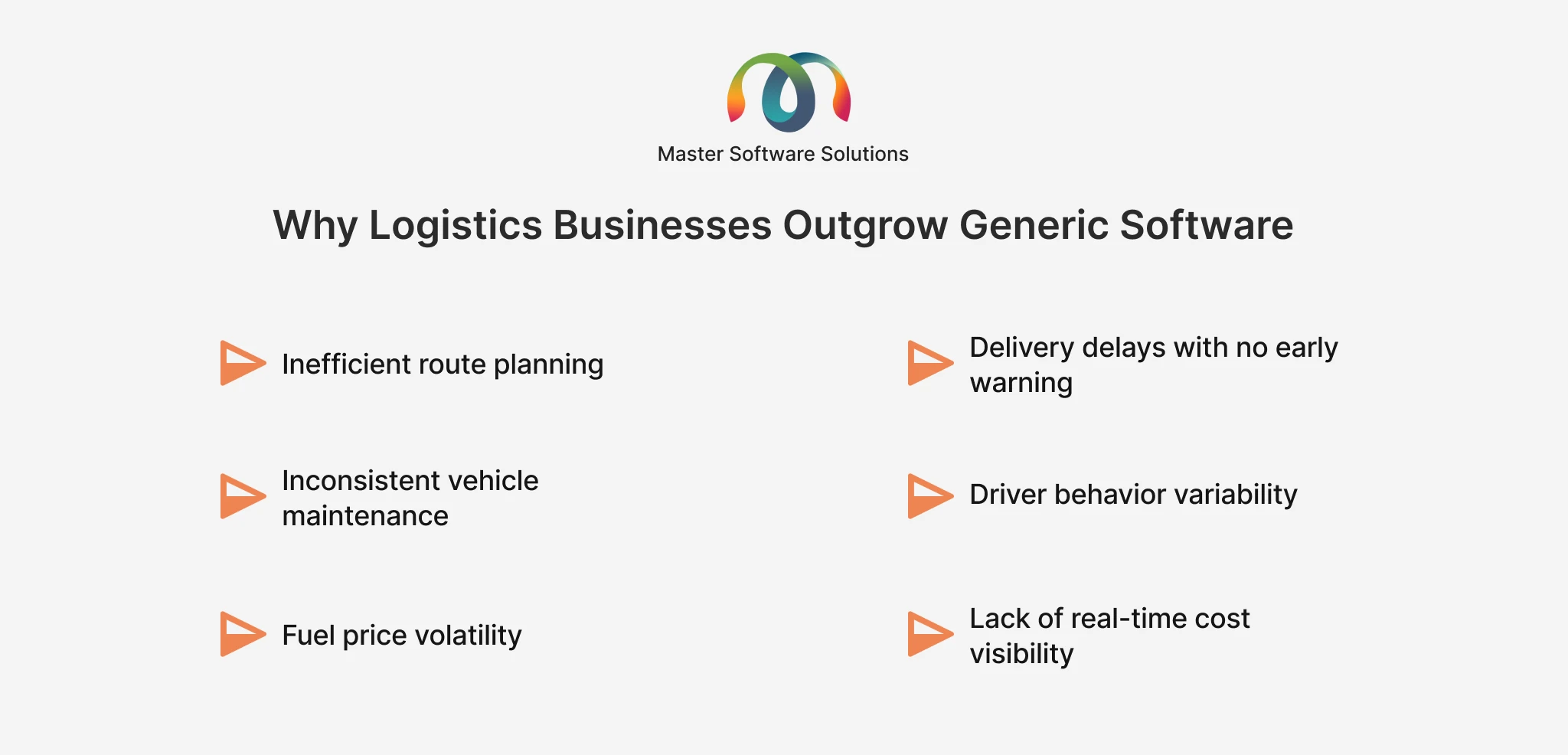
Logistics comes with a level of complexity that standard software cannot handle, leading to delays & missed deadlines. The major setbacks show up in a handful of predictable places, including:
Inefficient route planning
Without accurate route intelligence built into logistics operations, dispatchers end up planning routes manually or relying on driver judgment. This directly impacts fuel costs, extends delivery dates, and increases the risk of spoilage for time-sensitive goods.
Delivery delays with no early warning
No live visibility into where a shipment is actually located causes delivery delays. These delays are noticed by customers before they get discovered by the business. This damages the relationships logistics companies rely on.
Inconsistent vehicle maintenance
Poorly maintained engines, tires, and fluid levels reduce fuel efficiency and increase the likelihood of costly breakdowns mid-route.
Driver behavior variability
Harsh braking, letting the engine run while parked, and inconsistent speeds across a driver fleet can quietly push fuel consumption well above what well-planned routes would require.
Fuel price volatility
Without real-time cost tracking tied to actual routes and vehicles, businesses often don’t notice margin erosion from fuel price swings until it shows up in the quarterly numbers.
Lack of real-time cost visibility
When fuel and operating costs aren’t tracked against specific routes, vehicles, or drivers, there’s no clear data trail to identify where the inefficiency is actually coming from, so it keeps recurring.
What Odoo ERP Brings to Logistics Operations
Odoo ERP is an open-source enterprise software solution that plays a significant role in logistics. The system is built from modules to meet business needs, and all these modules share one database to maintain data consistency, productivity & efficiency.
Inventory & Warehouse Management
This module offers real-time stock visibility across every location, including barcode & RFID tracking, and eliminates manual intervention & errors. This matters most in logistics during peak volume, when higher shipment counts have to be managed. Want to explore inventory management in detail? Our ultimate guide to Odoo inventory management walks through how this is configured in practice.
Purchase & Vendor Management
It includes an automated reordering process, with stock decisions based on real consumption patterns rather than guesswork. It also gives visibility into vendor performance, recurring delays & procurement to ensure tasks are planned without any uncertainty.
Sales & CRM
It consolidates every customer conversation, quotation & shipment history in one unified platform so that managers are not chasing information across different platforms. Every customer record is maintained to keep consistency across the sales team & build stronger client relationships from day one.
Fleet & Field Service Management
This involves tracking vehicles, maintenance schedules, and driver assignments to get fleet insights from the moment a task is assigned to the final destination. Scheduled maintenance helps detect mechanical issues before they turn into breakdowns mid-route. Driver assignments also record the driver’s complete journey through to completion.
Accounting & Invoicing
Accounting & invoicing is another feature Odoo ERP comes with. The data is directly connected to shipment & delivery, so invoices reflect what was originally quoted. This cuts billing disputes caused by partial deliveries or last-minute routing, and shortens the time between delivery & payment by removing manual data entry.
Document & Compliance Management
It centralizes shipping documents, customs paperwork, and delivery records in one system. This makes it easy to fetch the right document during an audit instead of digging through emails or physical files. For cross-border freight, it keeps every document connected to the shipment record.
Reporting & Business Intelligence
This Odoo ERP feature covers on-time delivery rates, fuel cost per route & warehouse turnover. This gives the team real numbers to make the right decision rather than relying on manual reports. Because the numbers reflect real-time data, gaps on a specific route can be identified and fixed quickly.
Customer Self-Service Portal
It lets customers check order status, track shipments, & download invoices, cutting routine support calls & giving the business a more transparent & professional customer experience. For recurring freight, the portal provides complete shipment history without any gaps. This transparency builds trust between the business & its customers.
Key Odoo Features Built for Logistics-Specific Challenges
Beyond the core modules, there are several Odoo features that map directly to the pain points logistics businesses deal with. Let’s understand them.
Real-time inventory and shipment tracking
Barcode scanning updates stock movement, helping warehouse staff get real-time visibility and a clear picture instead of managing everything manually across different platforms.
Multi-warehouse and multi-location routing
Odoo ERP automatically assigns orders to a warehouse based on stock availability and proximity, rather than relying on someone to remember the right location.
Route and fleet optimization
Odoo ERP ensures delivery routes, vehicle assignments, and maintenance schedules are managed from one interface, reducing fuel wastage & giving dispatchers a clear view of fleet capacity before it’s committed to delivery.
For businesses handling bulk deliveries across multiple locations, our Route Optimization plugin helps you build the most efficient delivery sequence, view optimized routes on a map & track driver locations.
Automated documentation and invoicing
Shipping documents, customs paperwork, and invoices are generated directly from order and delivery data. This removes the manual double-entry that causes errors and delays in payment cycles.
Customer-facing tracking portals
Customers can check shipment status themselves instead of calling the help or service number. This integrated ERP solution automatically reduces support load & gives logistics companies a more professional, transparent customer experience.
Demand forecasting
Odoo ERP implementation includes built-in reporting and forecasting tools that help logistics businesses anticipate seasonal spikes and plan warehouse capacity rather than reacting when volume has already surged.
Odoo ERP Across Logistics-Heavy Industries
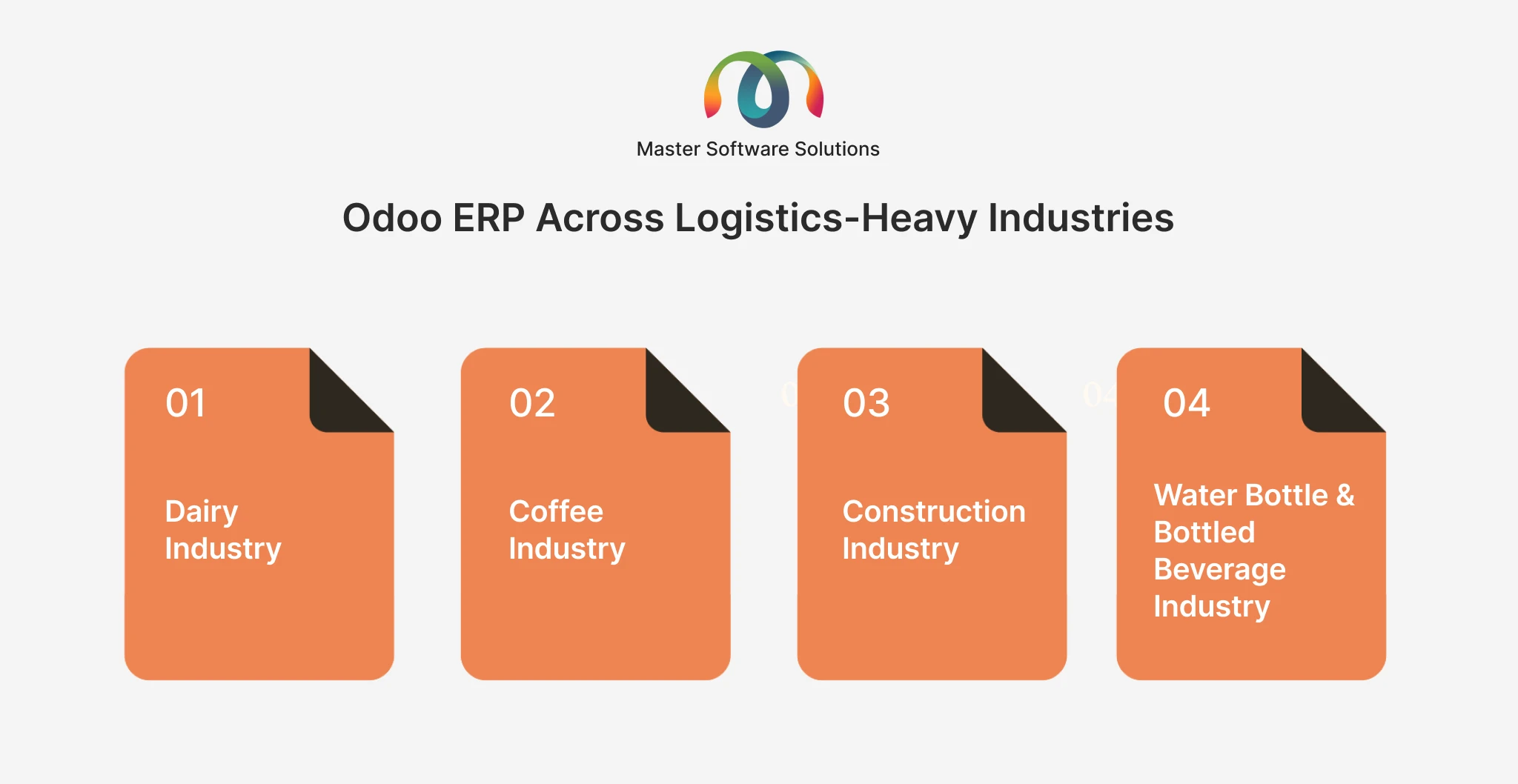
Logistics isn’t an isolated sector; it’s the operational backbone running underneath dairy, food and beverage, construction, and manufacturing businesses, and each of these industries puts a different kind of pressure on that backbone. Want to explore how a wide range of industries benefit from Odoo implementation? Explore our guide to understand how logistics operations move from manual to automated.
Dairy Industry
Dairy logistics runs on a clock that most industries don’t think about. Milk and other dairy products are perishable and have a short shelf life. Deliveries need to be planned around specific temperatures, freshness & delivery routes to avoid spoilage.
From batch and lot tracking across collection, processing, and delivery to time-sensitive routing and demand forecasting, Odoo ERP plays a vital role. For dairy businesses running multiple collection points and milk routes while following food safety & HACCP compliance, ERP implementation helps protect both ROI & shelf life.
Coffee Industry
The coffee industry involves a supply chain from farm to roastery to final shipment, from tracking raw green coffee inventory separately from roasted stock and managing multiple supplier origins with different quality grades, to keeping batch-level records for roast dates. Odoo ERP is an ideal platform that manages multiple inventories & purchasing in a unified platform for real-time visibility of coffee stock.
Construction Industry
Construction is less about finished products & more focused on getting the right material, such as cement, steel, aggregates, and fixtures, to the right job site at the right stage of the build. Odoo ERP purchase and inventory modules coordinate material procurement against project schedules, while fleet management keeps track of the vehicles and equipment moving between multiple active sites. A construction supplier managing deliveries to several job sites can coordinate all of this data in a single platform to maintain consistency & productivity.
Water Bottle & Bottled Beverage Industry
Bottled water and beverage distribution is a high-volume, low-margin business where efficiency at scale is the major concern. Distributors manage large SKU volumes, while retail delivery routes & locations add a different level of complexity. Odoo route optimization keeps the delivery schedule fuel-efficient, and inventory management tracks both outbound stock & returnable containers, handling seasonal demand & accurate planning from warehouse to shipping.
Why the Right Odoo ERP Implementation Partner Matters
Choosing the right Odoo ERP implementation partner is a critical decision. A logistics company that runs multiple processes, like configuring routes, fleet tracking, and warehouse management, requires a consistent platform instead of paperwork for smooth business processes.
Workflow discovery
An experienced Odoo implementation partner starts by understanding your business goals & desired outcomes. They map existing dispatch processes and analyze warehouse layouts & delivery zones before configuring a single module. This helps them understand what the business actually needs.
Realistic route and warehouse rules
Configuration is set up against real operational patterns, peak volumes, delivery windows, and warehouse capacity rather than assumptions. The ideal implementation partner configures real routes & establishes warehouse rules to help the logistics business evolve.
Upgrade-safe customization
The right partner builds functionality in a way that survives future Odoo upgrades, so the business isn’t stuck on its current version with fragile customizations.
Structured rollout and support
An experienced Odoo partner tests against real scenarios and provides role-based training & post-go-live support to fix the inevitable gaps efficiently.
Want to discover the Odoo ERP implementation guide? Our blog will help you understand the process from planning to go-live.
Running a logistics operation on disconnected tools? Our team of Odoo ERP experts helps you configure your warehouse, fleet & delivery network.
Conclusion
Logistics businesses don’t need more software, but a system that handles the real complexity of goods movement across warehouses, fleets, and customer networks. Odoo ERP brings inventory, purchasing, fleet management, sales, and accounting into a single connected platform for real-time visibility of logistics operations.
As a trusted Odoo ERP implementation company, Master Software Solutions provides top-notch transportation and logistics solutions to manage and track your logistics. They include transport management, supply chain visibility, and network design management. Talk to our team today to get the right logistics solution.