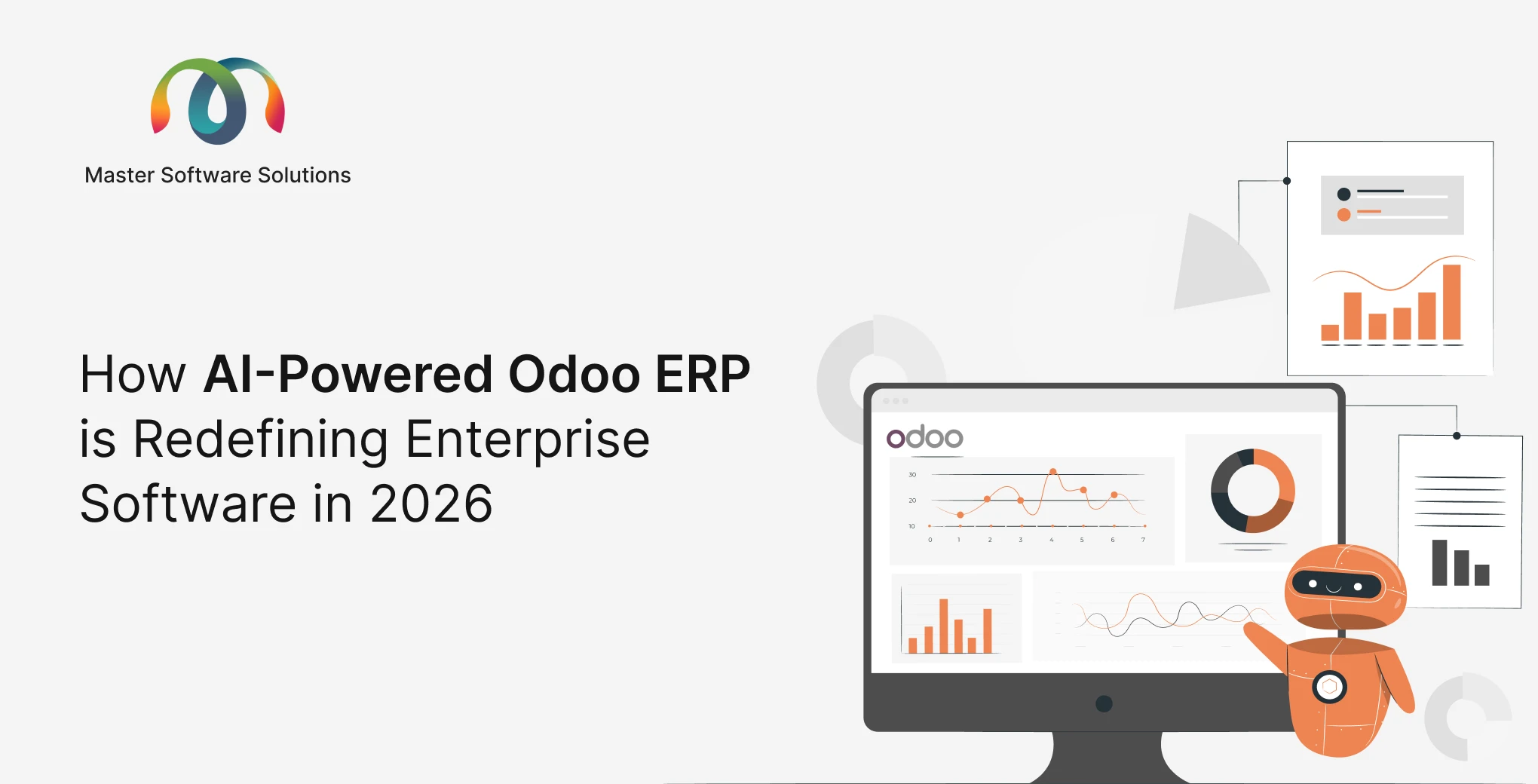
A growing enterprise business decides to modernize its ERP platform & every vendor in the room says the system is AI-powered. But the question is raised when someone from the team asks a real question, drafts a follow-up email from real pipeline data, or goes live in weeks instead of years, but it cannot be fulfilled because there is some missing parameter that is not fulfilled.
That missing gap is exactly what’s redefining software heading into 2026; AI is no longer a decision tool but has become a deciding factor in which platform a business chooses & those who are looking for complete operational complexity served in one place. Our blog on Odoo 20 & how it is refining enterprises helps you go through AI-enabled Odoo features, which are more prominent in Odoo 20 in 2026.
This blog breaks down what AI-powered Odoo ERP actually means in 2026 & why Odoo is a winning platform against the traditional enterprise giants.
Why Traditional ERP Systems Are No Longer Enough
Traditional ERP software is built for centralized records, standardized processes & gives every department a single source of truth. This was enough when the business goal was keeping data consistent across every platform. According to Salesforce Research, 81% of IT leaders say data silos are still hindering digital transformation efforts & most businesses are already running an ERP system.
Some key pointers make traditional ERP systems fall short of what growing businesses need today:
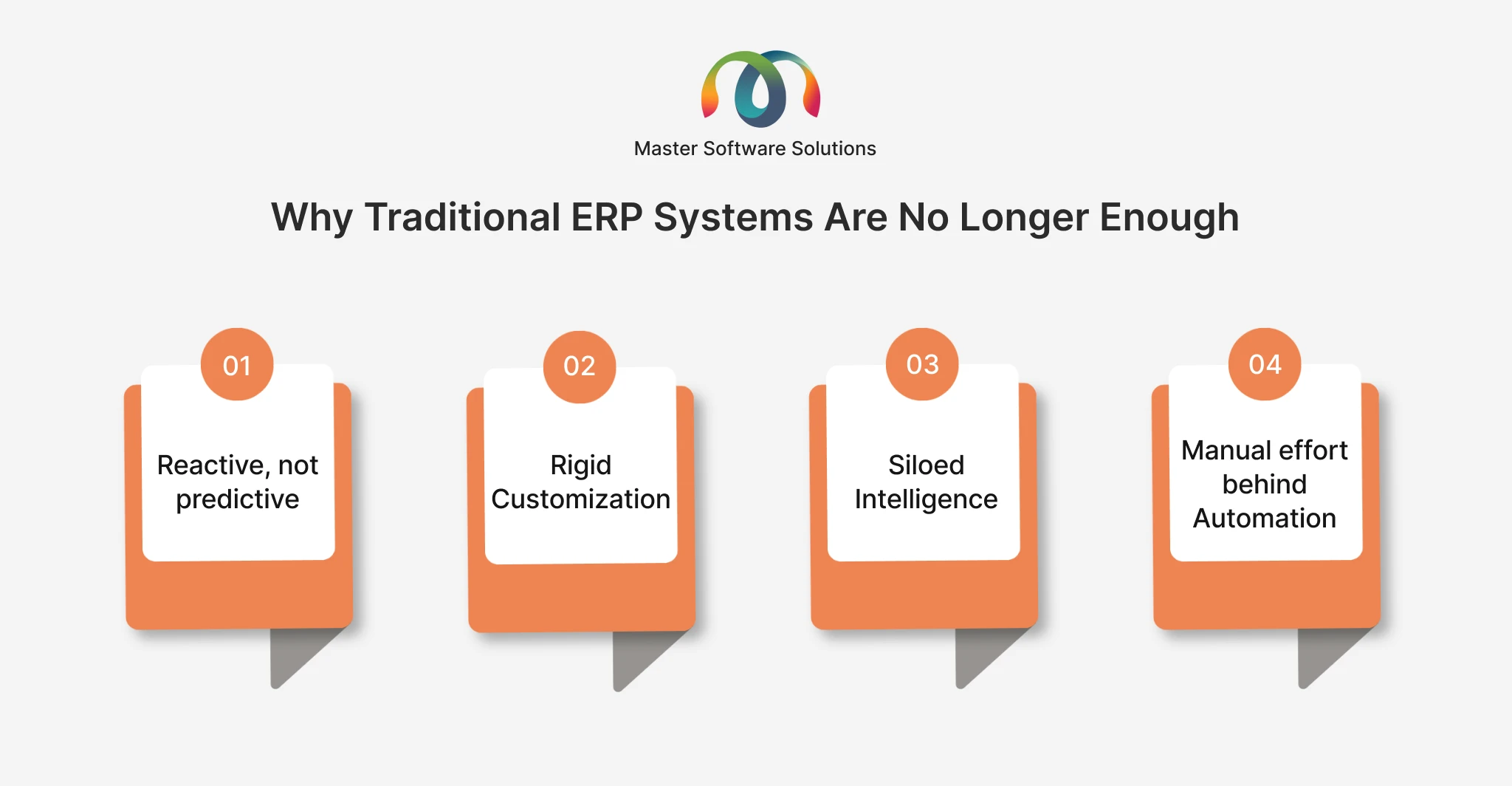
Reactive, Not Predictive
Traditional ERP reports tell you about the current details, a cash flow gap, a stockout, not demand forecasting & no real data analysis. It is usually reactive, but not productive.
Rigid Customization
Moving up with a legacy ERP system to a new workflow meant a normal change request, a development cycle & obviously cost. These factors discourage businesses from adjusting as their operations change.
Siloed Intelligence
When different modules sit inside the same platform, the insights are locked within their own module. Sales do not automatically inform inventory decisions, as well as finance does not automatically update in the CRM.
Manual Effort Behind Automation
Traditional ERP calls automation rule-based. It cannot handle judgment calls, drafting a response, or catching an anomaly that businesses actually need software to help with.
Implementation Cycles Can’t Keep Pace
A platform that takes years or more to deploy meaningful changes often struggles to keep up with how quickly businesses shift in 2026. This is the major factor that affects business performance, efficiency & productivity.
What AI-Based ERP Really Means in 2026
AI for Odoo ERP is a great advancement, but the real value depends on which of two approaches a business ends up with & that difference is what actually shapes growth & productivity. As per Gartner’s own research, it has been found that 28% of enterprise AI initiatives fully meet ROI expectations by embedding AI into their existing systems, rather than layering them separately.
AI-Enabled Systems
There are various add-ons in the existing software, i.e. a chatbot on top of the reporting module, a demand forecasting add-on, which is completely separate from the core suite. AI sits beside, not within, the ERP itself. This creates a clear gap between the business and what is exposed.
AI-Native Systems
AI is built into the platform’s actual architecture so that it reads data, answers documents, & takes real actions across various modules. It provides real-time visibility to businesses to take action & make decisions. Odoo 19 is a clear example of this significant shift that ships native AI agents into smarter tools, which are capable of smart document processing, automated forecasting, predictive inventory & AI-driven decisions.
Why the Difference Matters
An AI-enabled chatbot helps businesses to answer a question about a specific action without making more effort.
Want to explore the complete sales pipeline? AI automatically understands the information & drafts the follow-up email & quickly flags the risk of overdue, payment done, or in-progress mode.
It serves as a first real filter for businesses to run their operations smoothly by integrating the information in one platform, rather than scattered across disconnected tools.
Seeking to explore ERP implementation in detail, our guide to AI agent integration will showcase the benefits, methods & examples to get a clearer picture.
Why Odoo Is Beating SAP, Oracle, and Microsoft Dynamics
Odoo ERP is an open-source, enterprise-grade software solution that beats SAP, Oracle, as well as Microsoft Dynamics, and narrows the gap between two different worlds faster than the pricing gap.
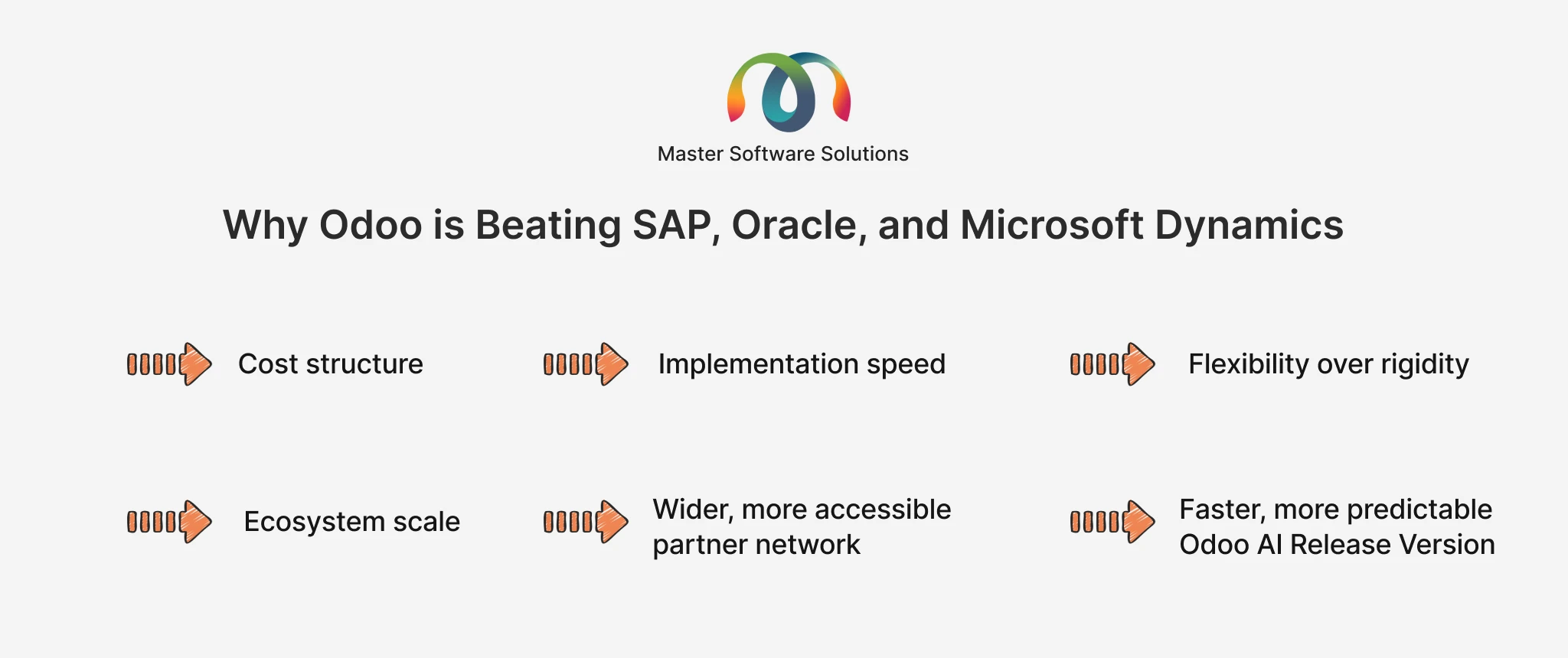
Cost Structure
Odoo comes in a free and an enterprise edition. It is free to run to start, but according to the additional customization, the cost rises. The customization contracts are typically with SAP, Oracle & Microsoft Dynamics, different from Odoo. That difference creates a realistic change in businesses to add AI-driven automation to their operations.
Implementation Speed
SAP, Oracle, as well as Microsoft Dynamics are scoped as long, phased enterprise projects. Odoo’s modular structure lets businesses fill those gaps, whether it’s in Accounting, Inventory, or other modules, and add AI-enabled modules rather than waiting for a single large rollout.
Flexibility Over Rigidity
Odoo architecture is modular by design, helping enterprise businesses configure workflows & add functionality as they grow. That flexibility feature directly extends to AI so that it is not restricted to one workflow to meet complexity.
Ecosystem Scale
AI-powered roadmap entirely depends upon the developer base. The software that is restricted to certain modules & functionality is extended further across industries, not only by Odoo’s own product team.
Wider, More Accessible Partner Network
Odoo’s official partner network spans various countries, giving businesses a real choice to implement & support their team. That broader approach to the network means the business is not locked into a single implementation pricing manually, it can be configured, scaled according to business needs.
Faster, More Predictable Odoo AI Release Version
Odoo moves to a new version every year. AI is a core part that updates with every edition rather than a separate track. Odoo 19 comes with advanced AI automation, which is not offered in SAP, Oracle, or Microsoft Dynamics, creating a disruptive upgrade for businesses.
How to Evaluate AI-Powered ERP
Most ERP businesses have shifted towards AI capability in 2026. But it comes with the most important question: “Does it have AI in its systems, & do businesses have a complete understanding of AI?” There are a few factors to evaluate AI-powered ERP.
Ask What the AI Agent Actually Does, and Where a Human Lacks
Before moving to AI-Powered Odoo ERP, businesses must have a complete understanding of their project, what shortcomings they are facing & where humans lack. It is especially important for businesses touching financial or customer data.
Ask Where It’s Already Proven, Not Just Promised
A feature that is live in production within real enterprise workflows is a completely different claim than creating a roadmap. It’s worth asking whether the capability being demonstrated is broadly available or just a limited edition.
Understand Whether the System Is AI-Native or AI-Enabled
It is the major point that businesses should be concerned with. This will test how AI is actually integrated into the platform, layered with. It will help you understand how much configuration flexibility your team needs to adapt to your workflows & exception handling. Our blog on integrating Odoo with Claude AI is a great example of how Odoo is integrated with Claude to deliver real value.
Check for Governance, Not Just Capability
A system that reads and acts on business data needs clear answers about data handling, auditability, and regulatory requirements compliance to train AI rather than just considering it.
Watch for Overstated Maturity
There is real pressure on businesses to position early-stage Odoo ERP as transformative. Rather than taking a demo of Odoo AI ERP features at face value, an independent vendor evaluation is what actually separates a good AI ERP decision from a costly one.
Conclusion
AI is not just added as a feature in an ERP system; it evolves businesses to get a real-time picture of it, which enhances value & focuses on the goal rather than facing disputes. Odoo ERP AI integration is a combination of AI visibility, modular flexibility & an improved cost structure that helps mid- to large-sized businesses close the gap at enterprise budgets. Businesses are getting real-time visibility from this shift in 2026 to evaluate AI-native architecture, proven use cases & complete compliance.
As a certified Odoo implementation partner, Master Software Solutions is your trusted partner to help businesses integrate new AI-powered features in Odoo & build the right ERP solution that they are actually expecting. Connect with our team today and get an AI-powered Odoo implementation that scales & grows your business.