Imagine a distribution company owner watching a demo. A team member asks an AI assistant: “Which customers are overdue?” & then, “How much stock is left of the best-selling product?” Within a few seconds, both the answers appear on the screen. The owner turns to the operations director & asks the common question that every leader is asking now: “Why are we paying for an ERP when AI answers it in seconds?”
A week later, the same team tried it on the real work platform. The AI assistant reports a customer as overdue, but the payment arrived two days ago & no one sees the bank file to cross-check the payment. That gap is the major concern of businesses.
AI is changing how people use business software, but whether it replaces the ERP is what you’re actually thinking of. This blog separates what AI can actually do & whether AI replaces ERP without putting your numbers at risk.
What Do You Mean by “AI Replacing ERP”?
When people say AI will replace ERP, they focus on three different things, including AI taking over the ERP platform itself, AI taking specific tasks such as data entry, report building & navigation that ERP does not provide, or AI taking the people who use the system.
These are three different questions with unique answers. ERP is a platform that stores the data, applies business rules, and keeps an audit trail. Whereas AI reads documents, answers questions in simple language, & drafts routine work.
What an ERP Does That AI Alone Cannot
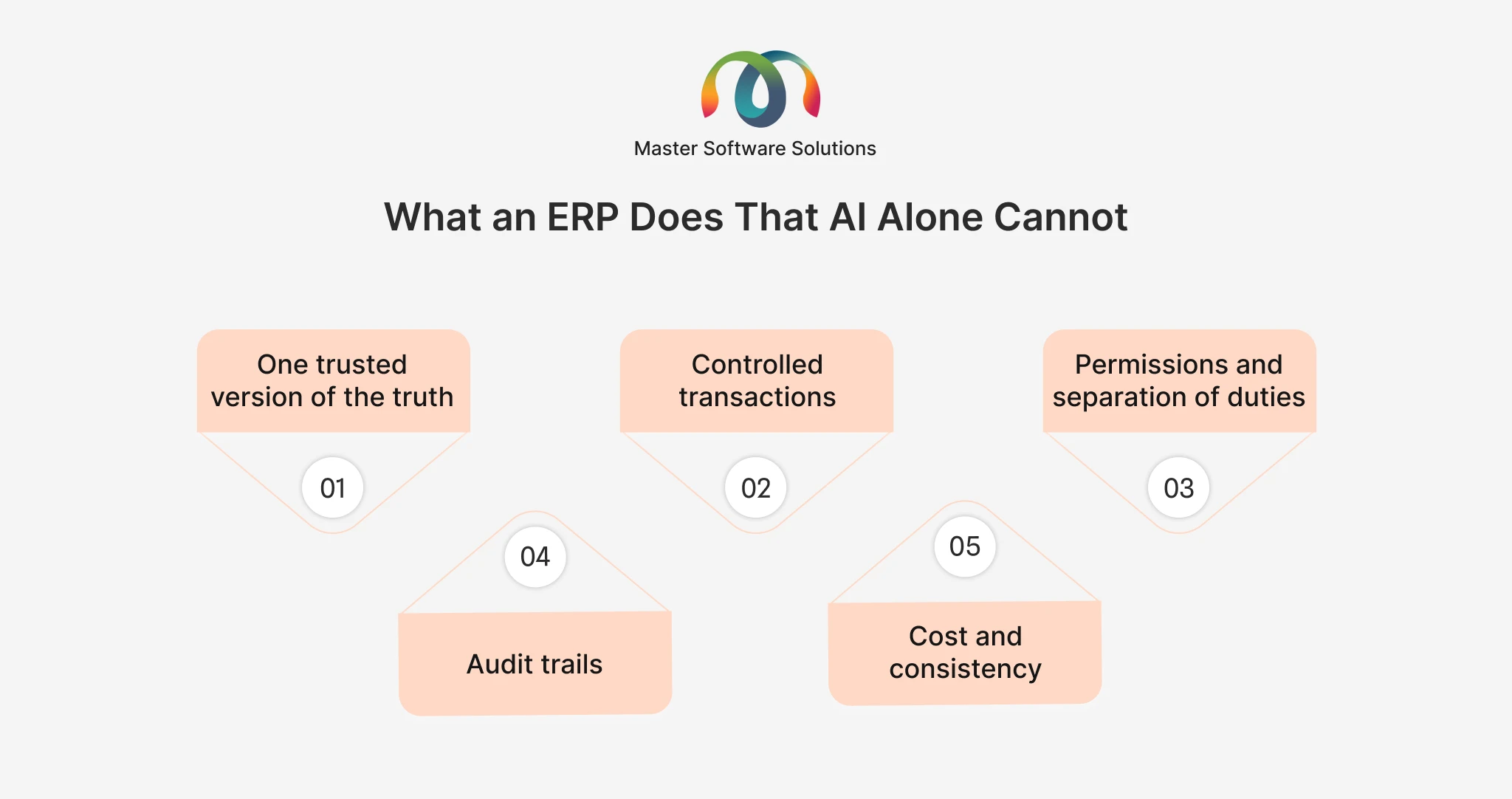
An AI-powered ERP platform comes with various capabilities that enable businesses to shift towards automation rather than manual intervention.
One trusted version of the truth
An ERP stores data in a defined structure, with one customer record, one product record, and one ledger. An AI model does not store your business data, as it encapsulates all the data in a unified platform for quick processing.
Controlled transactions
An ERP applies the business rule every time & is considered a poor fit, as it consumes time and requires repetition, which is not acceptable when AI is integrated with ERP.
Permissions and separation of duties
An ERP enforces permissions every time, but shifting to an AI broad access can quietly bypass those controls.
Audit trails
Auditors and regulators always ask who changed what, and when. An ERP needs to keep that history for validation, but conversation with an AI assistant does not.
Cost and consistency
Rule-based ERP logic is cheap to run at scale. Using an AI model adds usage costs on top of your software licenses, and gives results that vary.
What AI Really Changes Inside an ERP
AI is not considered a minor add-on, it removes real challenges businesses go through. It serves practical value in various areas that include:
Document entry
Automated document entry without team effort enables AI agents to read an invoice & create the bill in Odoo frequently based on auto-filled fields.
Answering questions in plain language
Ask an AI Agent a clear question & it replies in plain language that is easy to follow & understandable without any errors.
Finding exceptions
Flagging duplicate invoices, unusual expenses, late deliveries, and stock that is not moving.
Forecasting and planning
Demand forecasts, cash flow projections, and reorder suggestions will be generated based on history.
Multi-step agents
AI acts as a multi-step agent that encapsulates a large number of tasks, for example, checking stock, drafting a purchase order, and routing it for approval.
Where the Hype Runs Ahead of Reality
There are 2 genuine market data points from analysts who forecast strong AI growth. Here’s what the market evidence says.
What Gartner says about agentic AI
- Over 40% of agentic AI projects will be canceled by the end of 2027 & the major reasons are rising costs, unclear business value, and weak risk controls.
- Most current projects are early-stage experiments, often driven by hype and encountering the wrong problems.
What the McKinsey study says
- Use of agentic AI is increasing, mostly showcased by large enterprises. Forty percent of respondents from large organizations (those with annual revenues of more than $1 billion) report scaling AI agents, up from 27 percent last year. The share of respondents from smaller organizations reporting scaling remained flat at 22 percent.
Three Ways Businesses Combine AI and ERP
Here, we will understand three major ways that help businesses combine AI & ERP to deliver great value.
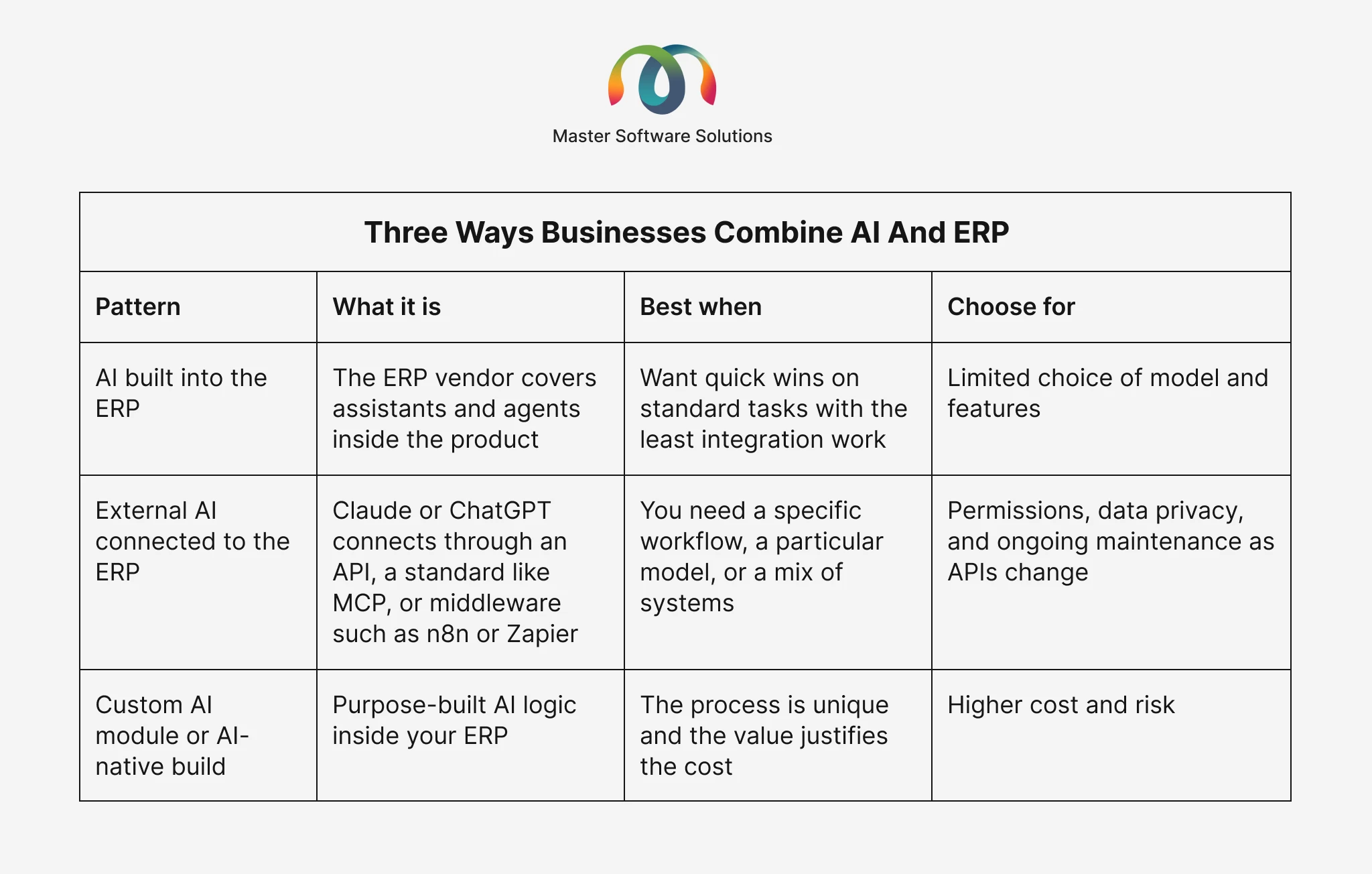
If you want to get the knowledge of external APIs connected to the ERP, like Claude AI, ChatGPT, n8n, Zapier & many more. Get details on integrating Odoo with Claude AI & how to automate Odoo workflows with Claude using n8n or Zapier & step by step process you can apply to your own setup.
Your AI-Powered Data Decides the Result
AI provides real-time information on whatever is asked. This model works on clean & consistent data, speeding up enhanced business performance & efficiency. If the model works on unreliable data, it leads to errors. Before integrating AI into your ERP, check for some major problems that include:
- Duplicate customer, vendor, or product records.
- Inconsistent categories defined differently by different teams.
- Approvals with no desired owner.
The Odoo implementation prerequisites list is a correct sequence for fixing this. It defines scope, best formats, duplication, and examines identifiers to maintain data quality after going live.
Do You Still Need an ERP? A Practical Test
A simple way to decide is to consider your business needs and what the system needs to do. Let’s understand.
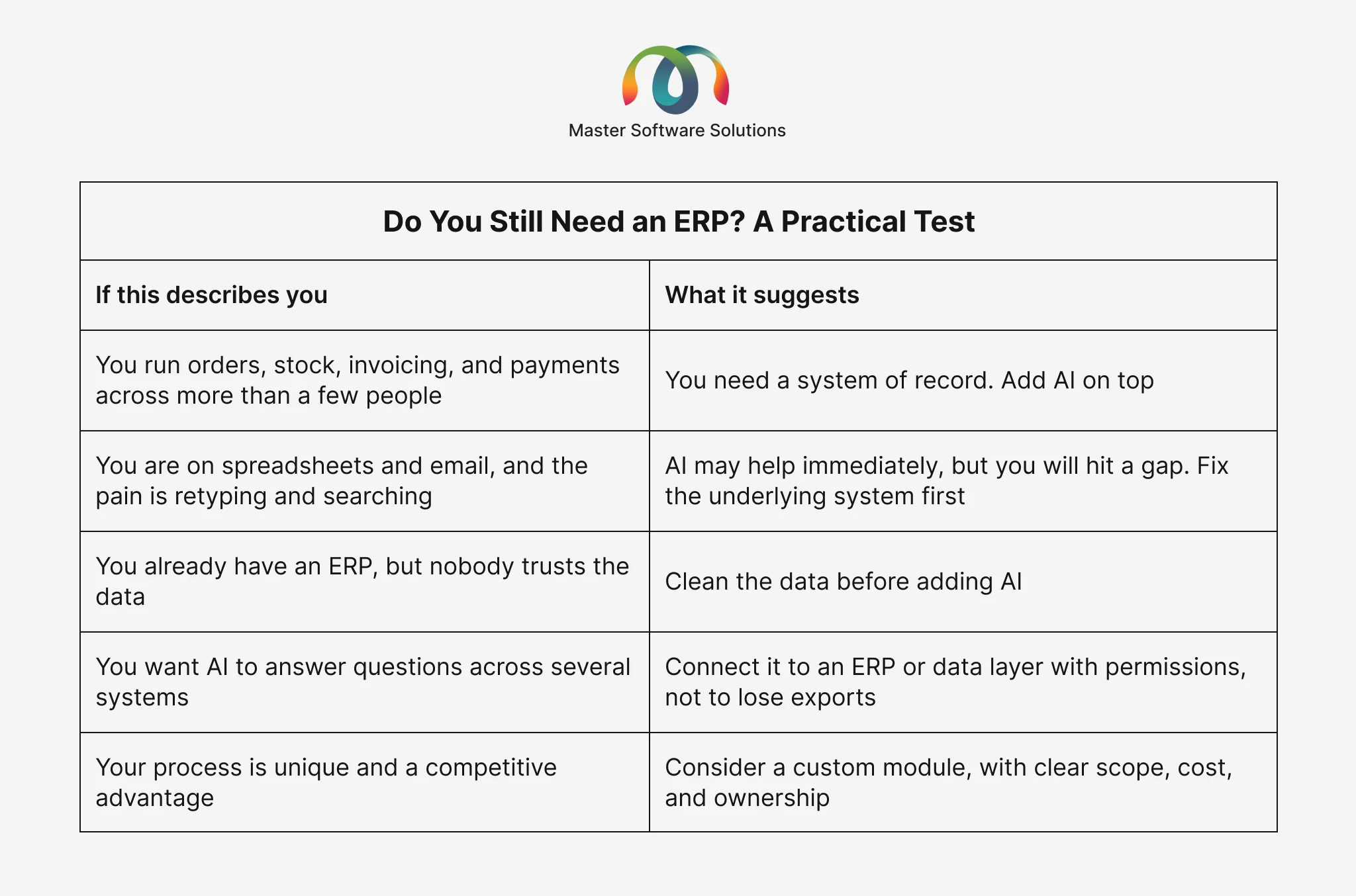
For small to large-sized businesses, ERP gets stronger with AI, not weaker. A single system with one database is easier to give an AI assistant accurate, permission-based data than scattered tools. The comparison of Odoo & legacy systems explains why a unified, AI ERP-driven platform is a better base for businesses to evolve & grow.
Conclusion
AI does not replace the need for an ERP, as it automates processes with an ERP for effective results. AI makes that system easier to use: it reads documents, answers questions in plain language & flags exceptions. Businesses that treat AI as a layer on top of a clean, governed system get faster and more accurate results.
Master Software Solutions is an Odoo Silver partner headquartered in Toronto, Canada, that helps businesses connect AI to Odoo with the right data checks, permissions, and approval steps. Talk to our Odoo team to find the first process where AI can save time without putting your numbers at risk.