Suppose it’s the end of the month, and a growing distribution company pulls inventory records from its ERP, cross-checks them against warehouse reports, and manually flags the mismatched entries. Their ERP holds complete data, including sales figures, stock levels, vendor invoices, and shipments. But none of that data talks to each other in a way that actually helps the business make faster decisions. This is the clear gap ERP AI integration addresses.
Businesses today are not struggling to collect data; most ERP systems do it well. What they are actually struggling with is turning raw data into something usable in real time, without manual intervention across disconnected tools. That’s the real shift AI integration brings: an ERP that stops being a passive record-keeper and starts actively processing, interpreting, and acting on data in the way the business actually needs.
What Does AI Integration in ERP Actually Mean?
AI integration in ERP is not a single feature you switch on; it is a complete layer of AI-powered capabilities, including machine learning, natural language processing (NLP), and computer vision, on top of the ERP data. Rather than treating the ERP as a static ledger (a traditional, rigid general ledger structure in accounting that mirrors paper formats), businesses can do more than record transactions. With AI-powered ERP integration, the system notices patterns, predicts the next step to be taken, and takes action on its own.
AI does not replace the ERP; it creates a data processing layer sitting behind your ERP. That layer works best when the underlying data is clean, structured, and centralized. Many businesses with disconnected legacy systems have found AI-powered ERP integration a valuable step, not just an add-on AI layer.
Our guide to migrating from legacy ERP to a unified platform serves as a real example of what makes AI integration the right step for growing businesses.
Why Enhanced Data Processing Matters More Than Ever
Data volume is never the bottleneck, but processing speed and quality definitely are. A business that runs multiple departments, including sales, inventory, finance, and HR, generates data faster than it can be processed manually. That data sits unprocessed as mismatched records, delayed forecasts, and decisions based on stale figures instead of real-time numbers.
According to a Gartner 2026 press release, finance organizations using cloud ERP applications with embedded AI assistants are expected to see a 30% faster financial close by 2028, and AI-enabled cloud ERP solutions are projected to account for 62% of total cloud ERP spending by 2027, up from just 14% in 2024. This is not a passing trend, but a clear signal that businesses want AI-driven data processing to become standard behind their operational processes.
Key Ways AI Integration Transforms ERP Data Processing
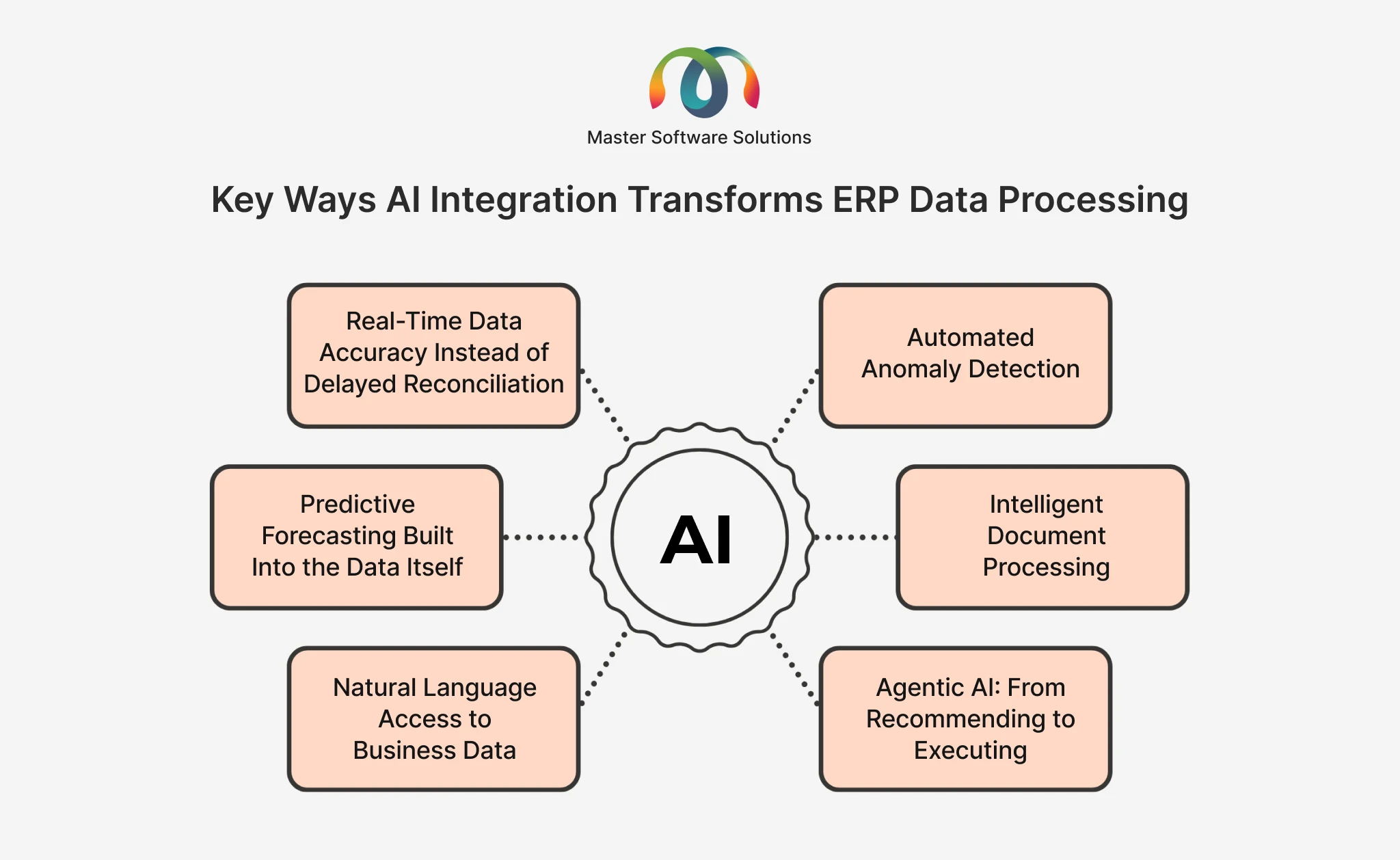
AI doesn’t change ERP data processing through a single upgrade. It brings distinct capabilities, each solving a different problem. Here’s where that shift is already happening in practice.
Real-Time Data Accuracy Instead of Delayed Reconciliation
Traditional ERP reporting mostly relies on batch updates or manual pulls, which means businesses are often working from outdated records when making a critical decision. AI-integrated systems process data in real time, so inventory counts, financial entries, and sales figures reflect what’s actually happening.
Automated Anomaly Detection
It’s time-consuming for the finance team to spot a duplicate invoice or an inventory count that doesn’t match shipment logs. AI-powered models trained on historical transaction patterns flag these irregularities automatically. This is one of the most immediately practical applications because it directly reduces manual audit work.
Predictive Forecasting Built Into the Data Itself
Rather than exporting historical data into a separate forecasting tool, AI-integrated ERP systems build forecasting directly into the data layer, anticipating cash flow gaps or demand spikes using the same data the ERP already tracks.
Intelligent Document Processing
A large share of business data still arrives as unstructured documents, such as vendor invoices, purchase orders, and compliance paperwork, which increases manual work. AI-powered document processing, using OCR combined with LLMs, converts these documents into structured, usable ERP data automatically instead of relying on manual data entry.
Many businesses that connected Odoo with Claude AI are already using AI in ERP to turn documents into ready-to-use records inside their ERP software.
Natural Language Access to Business Data
Not every manager wants to build a custom report to answer a simple question. Natural language processing lets businesses ask their ERP a direct question like “which vendors are trending over budget this month?” and get an answer from live data, without waiting on a report request to the IT team.
Agentic AI: From Recommending to Executing
The AI-powered layer that gives businesses the power to enhance their productivity is agentic AI. It doesn’t just flag an issue or suggest an action; it carries out multi-step tasks within defined business goals, such as updating stock levels, triggering reorder workflows, or routing an approval. This is a meaningful step beyond the assistive AI most ERP systems still rely on. Our blog on connecting Odoo to Claude through an MCP server is a strong example of connecting agentic AI with ERP for productive results.
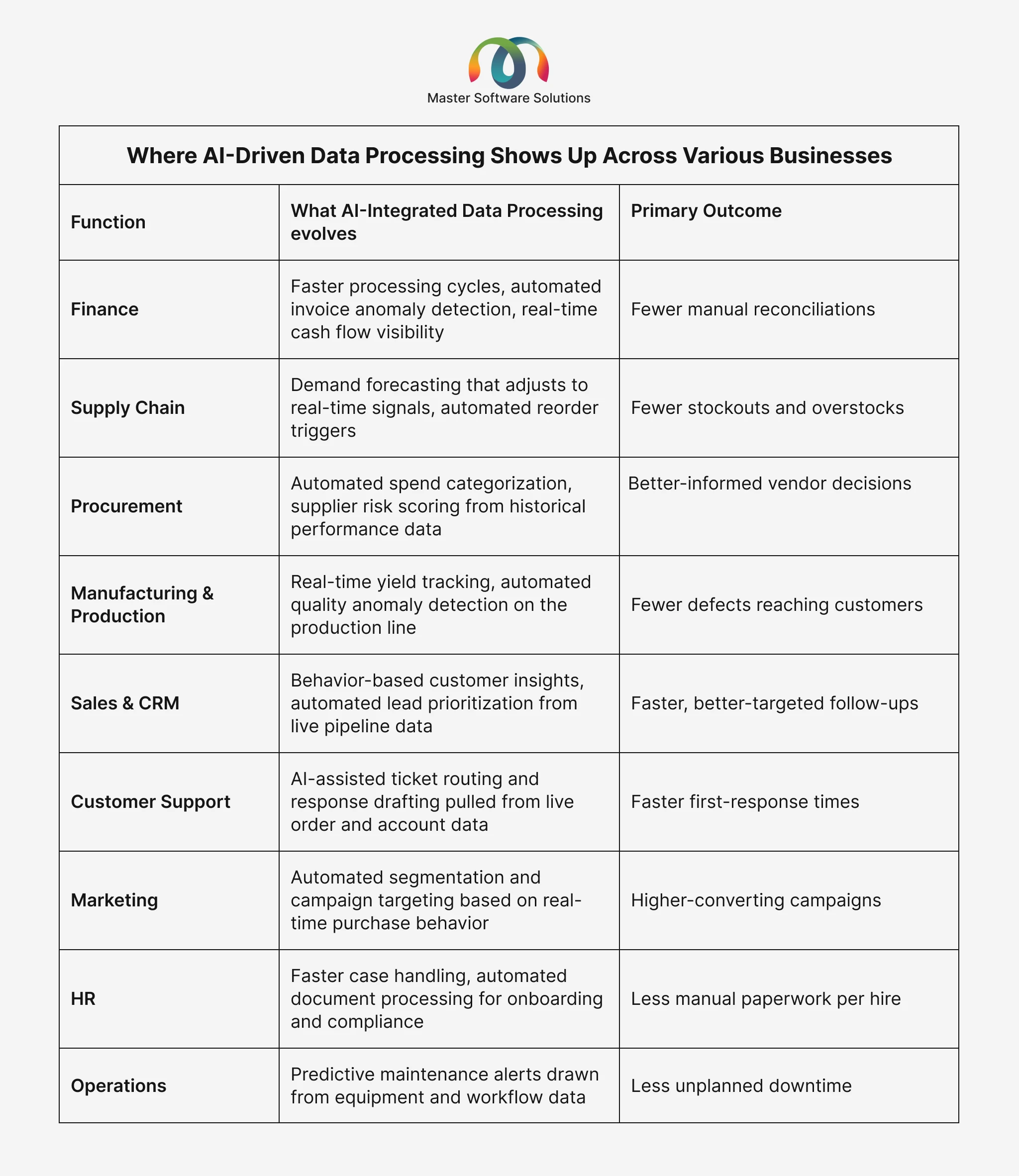
Where AI-Driven Data Processing Shows Up Across Various Businesses
Choosing the Right AI Technology for Your ERP Data
Choosing the right AI technology shapes the business’s data foundation and determines whether it delivers value-driven results.
- Not every AI tool integrates with an ERP and works to the business’s criteria. Integration choice matters more than most businesses expect.
- Some platforms are built only to layer a single AI assistant on top, adding a chat interface or basic automation without touching the underlying data pipeline. That approach rarely helps.
- Others are designed for deeper, agent-based automation that works across the entire data pipeline and executes multi-step tasks. Businesses should evaluate this capability carefully.
- The right choice depends on what a business actually needs from AI data processing, not on which AI tool sounds the most advanced.
- The comparison should be driven by specific data processing requirements (document handling, agentic workflow needs, and integration depth) rather than name recognition.
What Businesses Should Plan For Before Integrating AI
Planning plays a significant role before integrating AI, and it should focus on the business’s ERP foundation rather than execution alone.
- AI integration misses its real capability if it is bolted onto a messy data foundation.
- The most common challenges are inconsistent data quality, integration complexity across existing systems, and a shortage of in-house skills to manage the transition.
- Data quality is the biggest concern. If left unaddressed, poor data shows up in the AI’s output too, and the system won’t process data the way the business needs.
- Integration complexity across existing tools and systems needs to be mapped out before AI is layered into the ERP.
- An in-house skills gap is common and expected. Working with an experienced Odoo consulting partner often makes the difference between true AI automation and AI that still depends on manual data entry.
Conclusion
The businesses getting real value from ERP AI integration aren’t the ones chasing the most advanced model available. They’re the ones that treat data processing as the actual problem to solve: eliminating fragmented systems, structuring data properly, and then layering on AI capabilities. The significant shift AI-powered integration brings to ERP is not a flashy interface, but a faster and more efficient way to turn data into decisions.
Master Software Solutions is your trusted Odoo Silver Partner, with proven expertise in Odoo ERP integration services. Whether you need to integrate payment gateways, eCommerce platforms, CRMs, accounting software, or custom business apps, our Odoo ERP integrations ensure seamless compatibility and performance.