A business running Odoo 19 gets a notification that Odoo 20 has been officially launched. The IT team notes many changes, AI agents, a redesigned website assistant, as well as new payment processes. But the question on the table is not whether we should upgrade to a newer version or whether it should be upgraded right now. This is the exact position a lot of businesses find themselves in every time.
Odoo moved to a new annual release from Odoo 19 to Odoo 20. Odoo 20 was revealed at Odoo Experience 2026 in Brussels on 24 September and is not an exception. It includes many advanced features that help businesses evolve from reactive to proactive. The new Odoo version release does not mean that every business should move immediately.
This guide walks through the actual differences between Odoo 20 & Odoo 19, what an upgrade really costs & how to decide which version is the right fit for your business.
What is Odoo 19?
Odoo 19 launched in September 2025 and has since matured into a stable, production-ready release, currently at version 19.3 as of mid-2026. It introduced the foundation of Odoo’s native AI capabilities: “Ask AI,” a natural-language interface for querying business data, configurable AI agents, and AI-powered server actions connected to OpenAI and Google Gemini. Beyond AI, Odoo 19 brought offline-first mobile functionality, Manufacturing Kanban improvements, and enhanced CRM automation. For businesses that value stability and a full year of real-world use behind the platform, Odoo 19 remains a solid, well-tested choice.
What is Odoo 20?
Odoo 20 officially launched at Odoo Experience 2026 in Brussels on September 24th, and it’s a substantially larger release than a typical annual update, 585 confirmed changes across 52 apps, including 249 new features and 296 enhancements. Its biggest shift is AI moving from assistive to agentic: AI agents that can now answer questions about an uploaded file and handle more of a task with less step-by-step prompting. That AI push extends well beyond the core agent framework too, showing up as an AI Website Assistant, AI-assisted product editing in eCommerce, and AI-assisted campaign creation in marketing, alongside 16 new payment processors and deeper Planning-to-Field Service integration.
Odoo 20 Vs Odoo 19: Key Differences
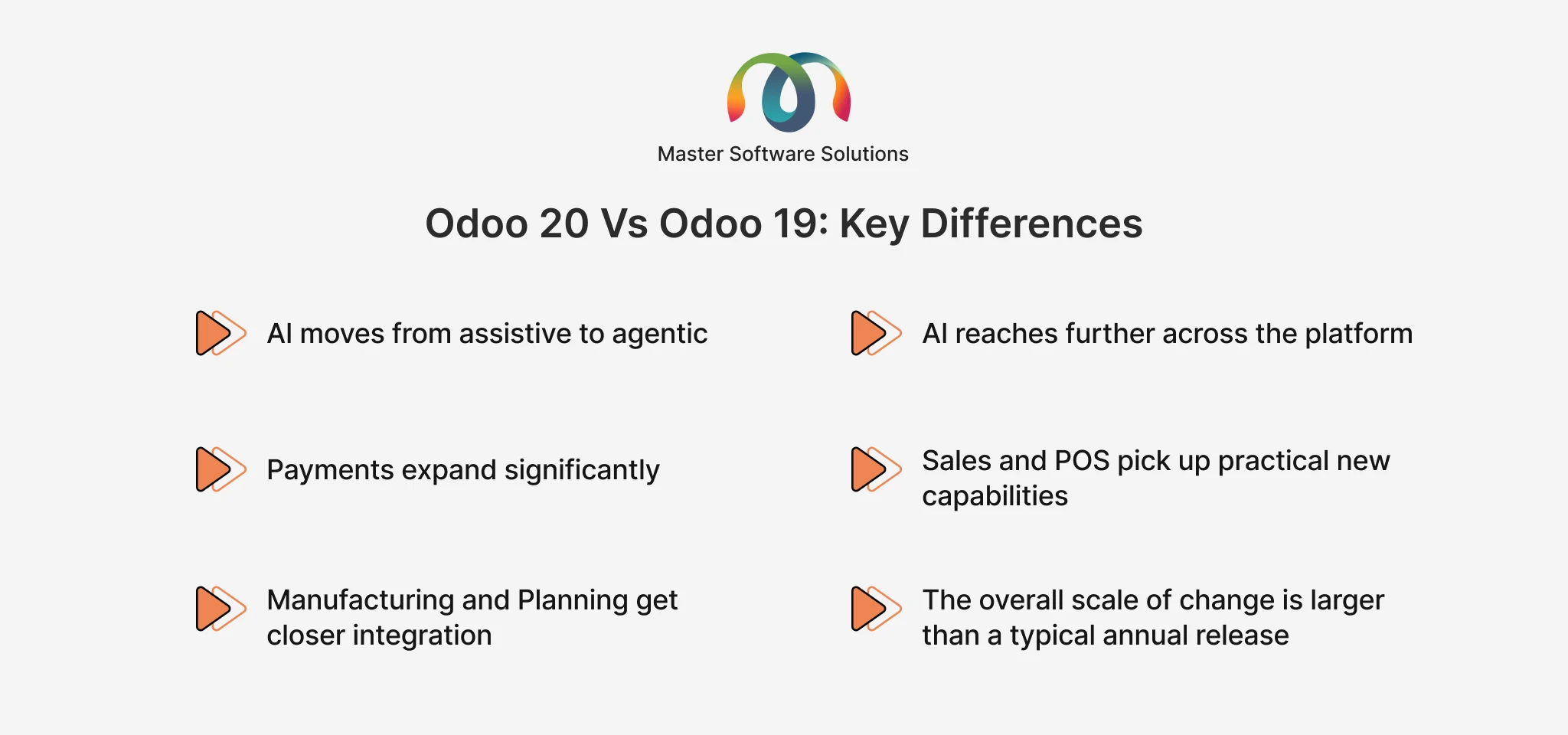
AI moves from assistive to agentic
It is found that Odoo 19 introduced the foundation: “Ask AI” serves as a natural language interface, with AI-powered server actions directly connected to LLM models, i.e., OpenAI & Google Gemini. On the other hand, Odoo 20 introduces agentic automation & AI agents answer questions & step towards Odoo AI features for independent task handling with a single prompt.
AI reaches further across the platform
Odoo 20 is further upgraded to an AI website assistant, AI-assisted product editing for the eCommerce platform, along with AI-assisted campaign creation in marketing. Whereas Odoo 19 was introduced as a core framework for operating business operations.
Payments expand significantly
Odoo comes up with different online payment processors that include ACH (electronic bank-to-bank transfers used primarily in the US for processing customer invoice payments) and Authorize.net, a significant shift for businesses that rely on third-party integrations for region-specific or specialized payment methods under Odoo 19.
Sales and POS pick up practical new capabilities
Odoo 20 introduces advanced payment-based commission & overall charging in Sales, Kanban & pivot support in the Point of Sale module. None of these capabilities existed in Odoo 19.
Manufacturing and Planning get closer integration
Odoo 20 builds a stronger connection between planning and field service, alongside further smarter manufacturing updates that are specifically designed around Manufacturing Kanban improvements. Odoo 19 already introduced these features, but not at an advanced level.
The overall scale of change is larger than a typical annual release
Odoo 20 comes with various new features & enhancements that help businesses gain greater traction in their operations. These new upgrades make this version worth evaluating more than Odoo 19, rather than treating it as a simple upgrade.
Comparison Between Odoo 20 and Odoo 19
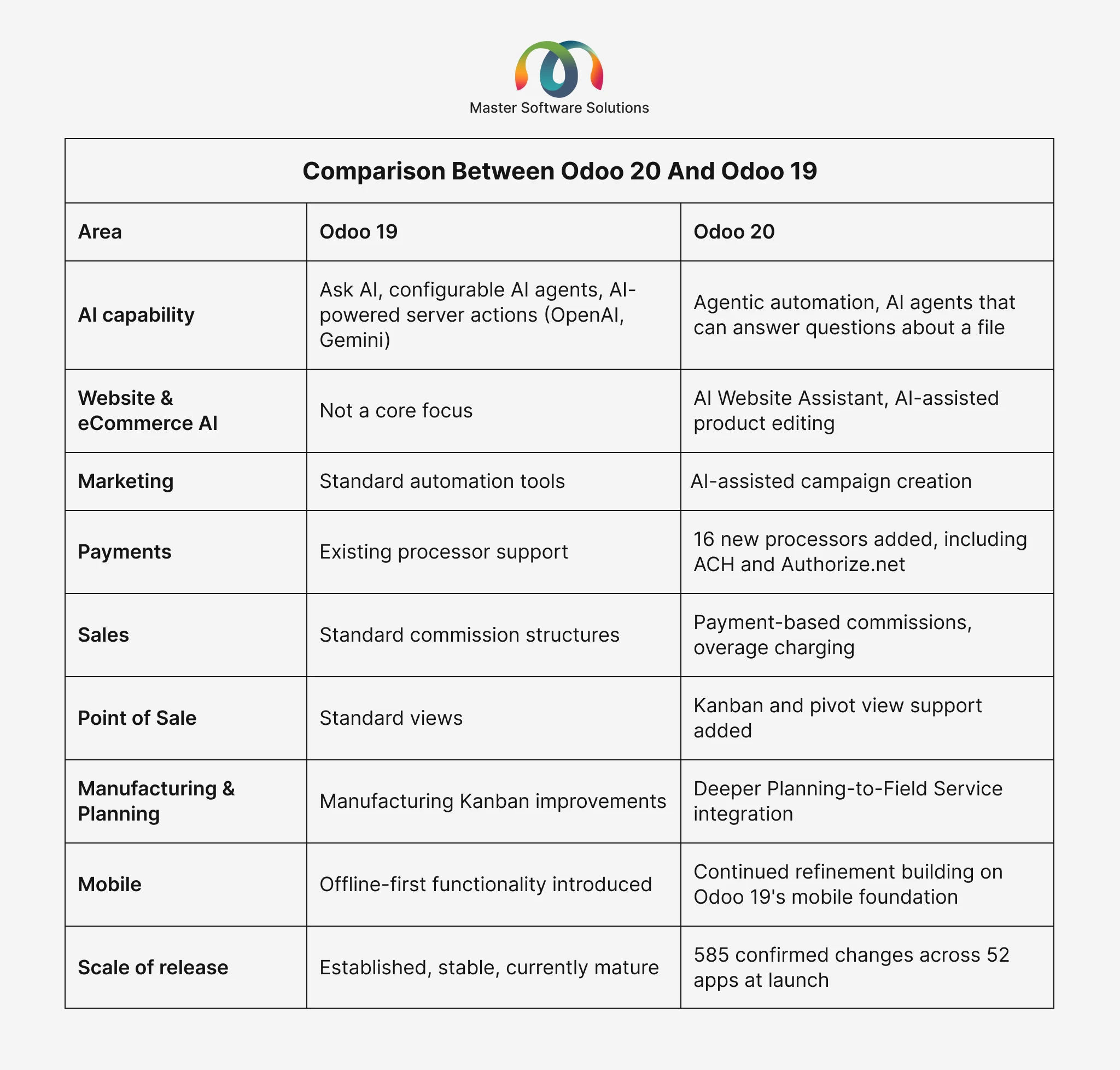
Above, we provide a comparison of Odoo 20 & Odoo 19. Want to get a better understanding of how the annual release of Odoo 19 creates a difference from other versions? Read our blog for a comparison between Odoo 19 vs. Odoo 18. This serves as a useful reference to explore the major differences.
What Does Upgrading Cost in Odoo 20 & Odoo 19
Upgrade cost is not a fixed number; it entirely depends on how businesses customize their current Odoo environment. A business that runs close to the standard Odoo edition, with custom modules that upgrade with less effort. Whereas a business with Studio customization or custom-built modules has to face a very different equation, i.e., every custom module needs to be reviewed & rested against the new version, where cost is the major factor.
Upgrading to Odoo 19
- Odoo 19 carries lower risk since it’s been in real-world use for a year and is currently at a mature 19.3 release
- Cost completely depends on customization: a simple & easy setup upgrade with modest effort.
- Comes with significant Studio customizations or custom modules that include reviewing, retesting, which directly affects the cost.
- Bigger financial risk for businesses that work on an outdated version, leading to increased operational costs & new additions.
- Standard & community editions come with different prices that vary as per the business needs & complexity.
Upgrading to Odoo 20
- Odoo 20 features introduce an entirely new cost calculation, since it was just launched at Odoo Experience 2026; businesses moving to it now are effectively the early adopters.
- Customization drives higher costs, exactly as it does with any Odoo upgrade
- There’s an added layer of risk on top of it: a freshly released version typically carries undocumented bugs, which is an added layer of risk.
- Odoo 20’s newer AI-agentic features specifically tend to need a few months of real-world use before they fully stabilize
- For businesses moving forward with complex customization immediately, that trade-off may be worth it for those businesses.
- For businesses running critical, highly customized workflows, this often keeps the upgrade cost more predictable.
At the same time, upgrading to a different newer version comes with its own risk that directly impacts the cost & enables businesses to pay extra charges. The upgrade entirely depends on customizations & integrations.
For a complete breakdown of how the upgrade process itself works, our Odoo 19 migration service guide walks through what an Odoo migration actually involves, regardless of which version you’re moving to.
Which Version is Better? Odoo 20 or Odoo 19
When this question comes up, it has different perspectives, as per actual business needs & futuristic outcomes.
Stay in Odoo 19
If your system creates real operational bottlenecks or compliance gaps with growing needs. Businesses move to the Odoo 19 version, when they need stability more than the newest AI capability. On the other hand, when the implementation timeline does not allow room for a freshly launched version to mature. For small to mid-sized businesses, Odoo 19 is a well-established release with the complete suite of modules behind it.
Move to Odoo 20
If your business is running close to standard Odoo with minimal customization, shifting to Odoo 20 is a convenient move that makes the path simpler & holds new capabilities, agentic AI, expanded payment processors & deeper planning-to-Field Service integration.
Wait before moving to Odoo 20 if you’re running heavy Studio customizations or custom modules that will need to be reviewed and ported, or if your business runs critical processes like invoicing and payroll.
For most businesses, the practical approach is the same one that applies to any Odoo upgrade: Our Odoo ERP implementation guide covers how that scoping process works in more detail & helps you get a major understanding of Odoo ERP implementation.
Conclusion
Odoo 20 represents a genuinely substantial release, not a routine annual update, and its deeper push into agentic AI across sales, website, and marketing workflows reflects where Odoo is clearly headed. But “substantial” doesn’t mean “urgent” for every business. The right move is the one that matches your current system’s stability, your customization footprint, and whether the specific new capabilities actually solve a problem you have today.
As a certified Odoo Silver Partner headquartered in Toronto, Canada, Master Software Solutions can walk through your current setup and help you make the right decision, whether staying on Odoo 19, upgrading now, or waiting for Odoo 20 to mature is the right call for your business. Contact our team to get a genuine Odoo consultation.